In this article
A few principles before you start
A newborn chart is a lovely thing to look at, and an easy thing to get wrong. Before any planet or sign, it helps to agree on what the chart is for. It is a symbolic portrait, a set of themes you can hold lightly while you watch a real child grow. It is never a description of who they must become.
A few principles keep the reading kind:
- A child is not their chart. The chart describes tendencies and needs. The child in front of you is always the better source.
- Describe, never label. “May find comfort in quiet routines” leaves room to grow. “Is a shy child” closes a door.
- Leave the future open. A baby’s chart says nothing about careers, grades or who they will love, so skip those questions entirely.
- Watch for your own hopes. It is very easy to find in a chart the child you wished for. Notice when that happens.
- Siblings are not rivals. Two charts in one family are two different skies, never a ranking.
One more boundary matters. Astrology has nothing to say about a baby’s health, development, feeding or sleep. Those belong with your midwife, your doctor and your own good sense, never with a chart.
A child is not their chart. The child in front of you is always the better source.
What you need: date, time and place
Like any birth chart, a baby’s chart needs three details. The date places the Sun, the Moon and the planets. The time and the place set the horizon, which gives the Ascendant and the twelve houses.
The time is usually the easiest of the three to find for a baby. It is often written on the hospital bracelet, the birth record or the discharge papers, and many parents remember it to the minute. If you are a grandparent or a friend preparing a gift, simply ask: most parents are glad to share it.
What to look at first, gently
You do not need to read every planet. Five pieces give a warm, rounded picture, and each one can be phrased as a need rather than a trait.
The Moon comes first with a baby. In astrology it stands for comfort: what soothes, what reassures, what feels like home. A Moon in a water sign may settle with closeness and a familiar voice; a Moon in an air sign may relax when there is something gentle to watch or hear. The Moon page explains the planet itself, and the Moon sign calculator finds the sign in seconds.
The Sun describes what lights a person up. For a baby, think of it as what may draw them out as they grow: the kind of play, wonder or company that makes them shine. It is a seed, never a forecast.
The Ascendant, or rising sign, describes the first approach to new people and new places. Some charts suggest a child who watches from a safe distance before joining in; others suggest one who reaches out straight away. Both are fine. Our guide to the big three goes deeper into the Sun, the Moon and the Ascendant together.
Mercury and Venus, briefly. Mercury hints at how a little one may take in the world: through sounds, pictures, stories or movement. Venus hints at what they may find lovely: colour, music, softness, faces.
The element balance closes the picture. Counting the planets by fire, earth, air and water shows the overall temperament of the chart, and it is often the most useful part for parents because it speaks in broad, gentle strokes.
A worked example: a little one born in Toronto
Let’s read an example chart for a made-up birth: a baby born on 6 March 2026 at 04:15 in Toronto. The Sun is in Pisces, the Moon in Libra and the Ascendant in Capricorn.
The Libra Moon suggests a little one who may be soothed by harmony: a calm room, a pleasant voice, faces that are glad to see them. Moon in Libra is often linked with a love of balance and company, so this baby may settle best when the people around them feel settled too. The page on Moon in Libra describes the placement in more depth.
The Pisces Sun hints at what may light them up over the years: imagination, music, stories, the soft edges of the world. You can read more about the sign on the Pisces page. With a Capricorn Ascendant, this child may meet new people a little carefully, taking their time before warming up. The pairing of a Pisces Sun with Capricorn rising has its own page.
Mercury and Venus are both in Pisces as well, which repeats the same soft, imaginative note: a little one who may take in the world through feeling and atmosphere, and who may find beauty in sound and colour. See Venus in Pisces for that placement.
Counting the ten planets gives 2 in fire, 1 in earth, 2 in air and 5 in water, so water is the strongest element and earth the lightest. Yet the Ascendant is in Capricorn, an earth sign. A chart like this may describe a child who feels a great deal on the inside and meets the world with a quiet, steady outer manner. A light element is never something missing in the child; it is simply a quieter colour in the picture.
The tightest aspect in the chart is Sun △ Midheaven (trine), followed by Sun △ Jupiter (trine). A trine is an easy, flowing angle. Read gently, it suggests a little one whose sense of self and whatever they come to care about may sit together comfortably, with a warm, generous note from Jupiter. That is as far as a kind reading goes.
You can draw the same wheel for your own little one in a minute. The free calculator shows every planet with its sign and house, and lists the aspects, so you can follow the steps above on a real chart.
What not to do with a baby’s chart
Most of the care in reading a newborn chart is in what you leave out.
- Predicting careers or relationships. A chart cannot tell you who your child will be at thirty. Let them surprise you.
- Reading difficult aspects as problems. A square or an opposition describes a tension that can become strength. It is never a flaw waiting to appear.
- Comparing with siblings. “Your brother’s chart is easier” is a sentence no child should hear. Each chart stands alone.
- Explaining behaviour away. A chart is a reason to understand, never an excuse. Real needs deserve real attention, from real people.
If a reading starts to sound like a verdict, step back. The right tone is the one you would use if the child could read it over your shoulder one day.
Read a baby’s chart in the tone you would use if they could read it over your shoulder one day.
A keepsake: the baby book and the nursery poster
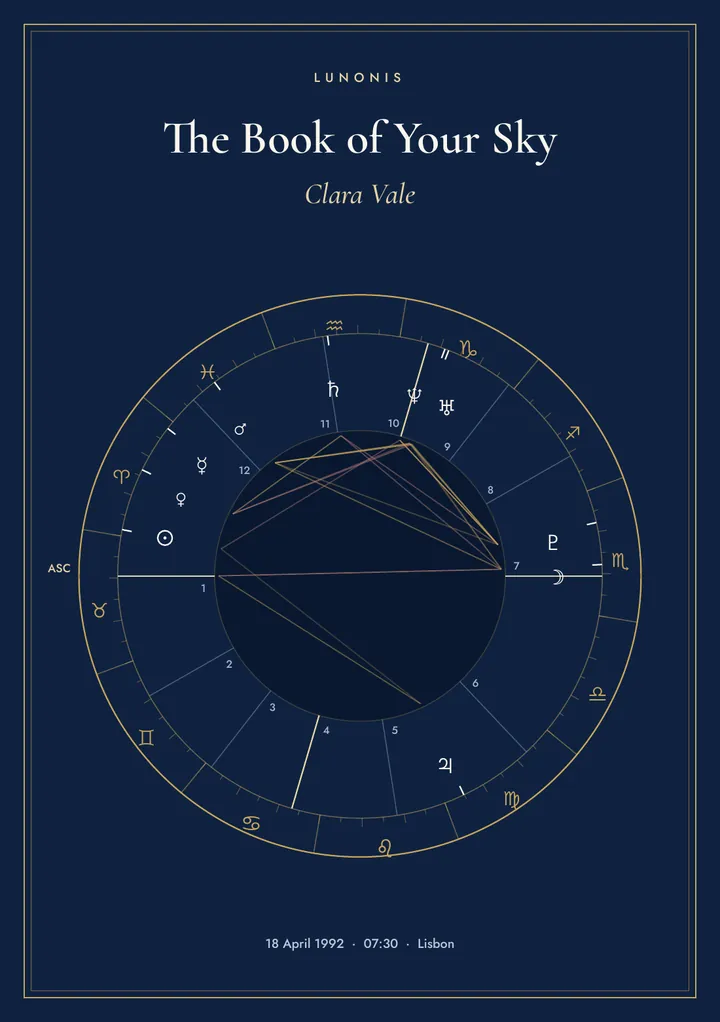
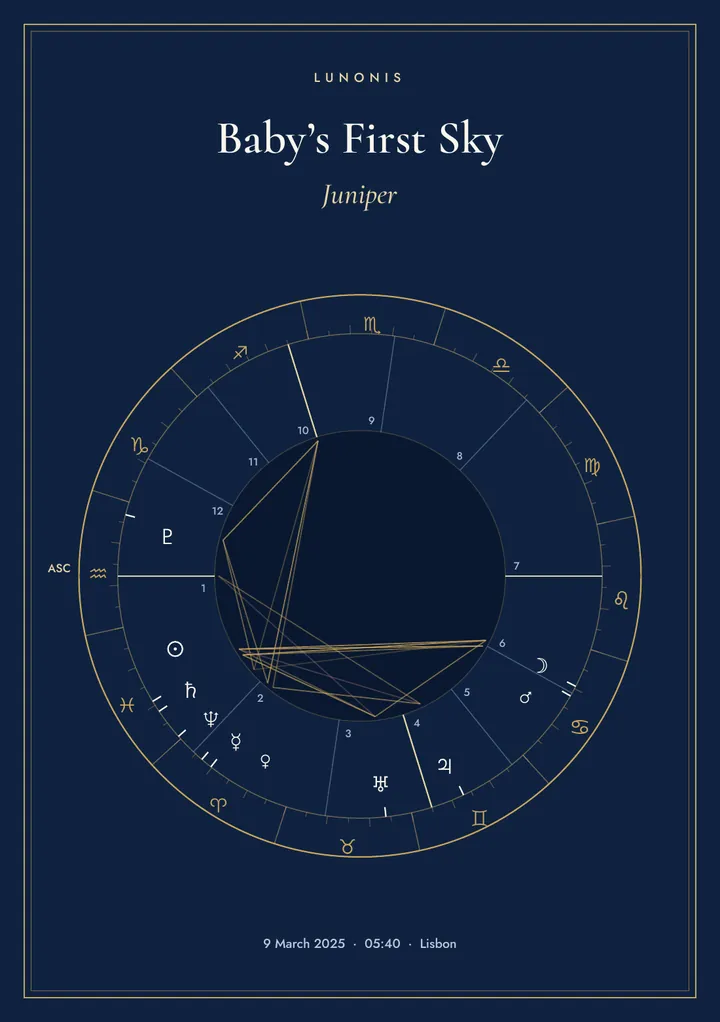
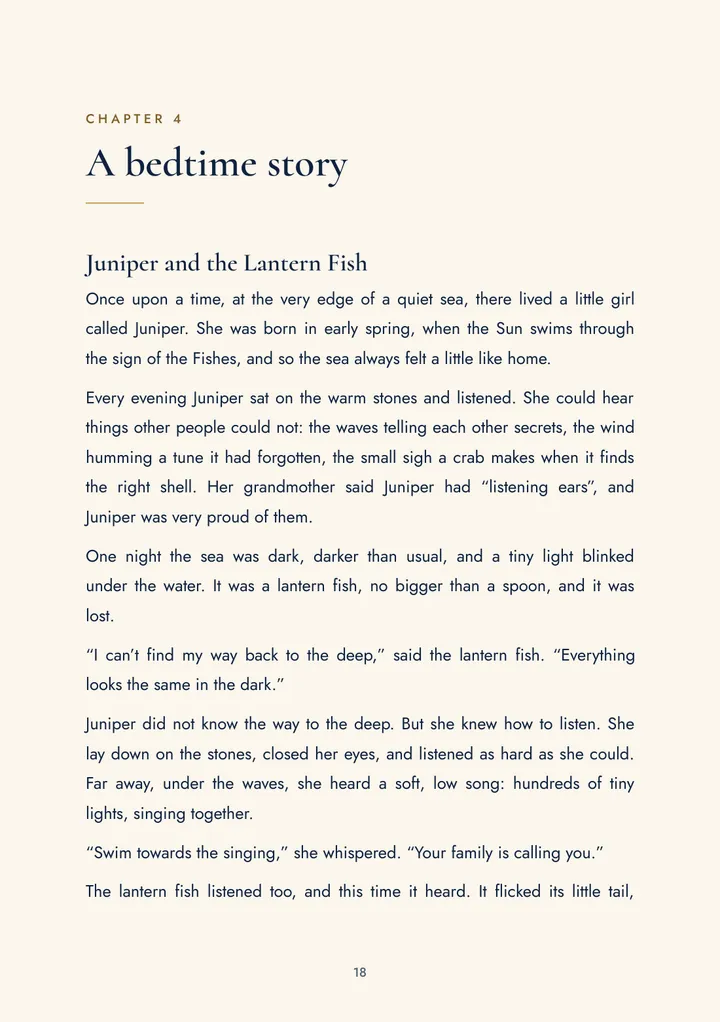
Many parents and gift-givers want something to keep rather than a screen to scroll. The Lunonis baby book is written from one exact chart, in gentle chapters addressed to the parents: what may comfort this little one, what may delight them, how they may meet the world. It ends with a bedtime story built from the same sky. There are no labels and no predictions anywhere in it.
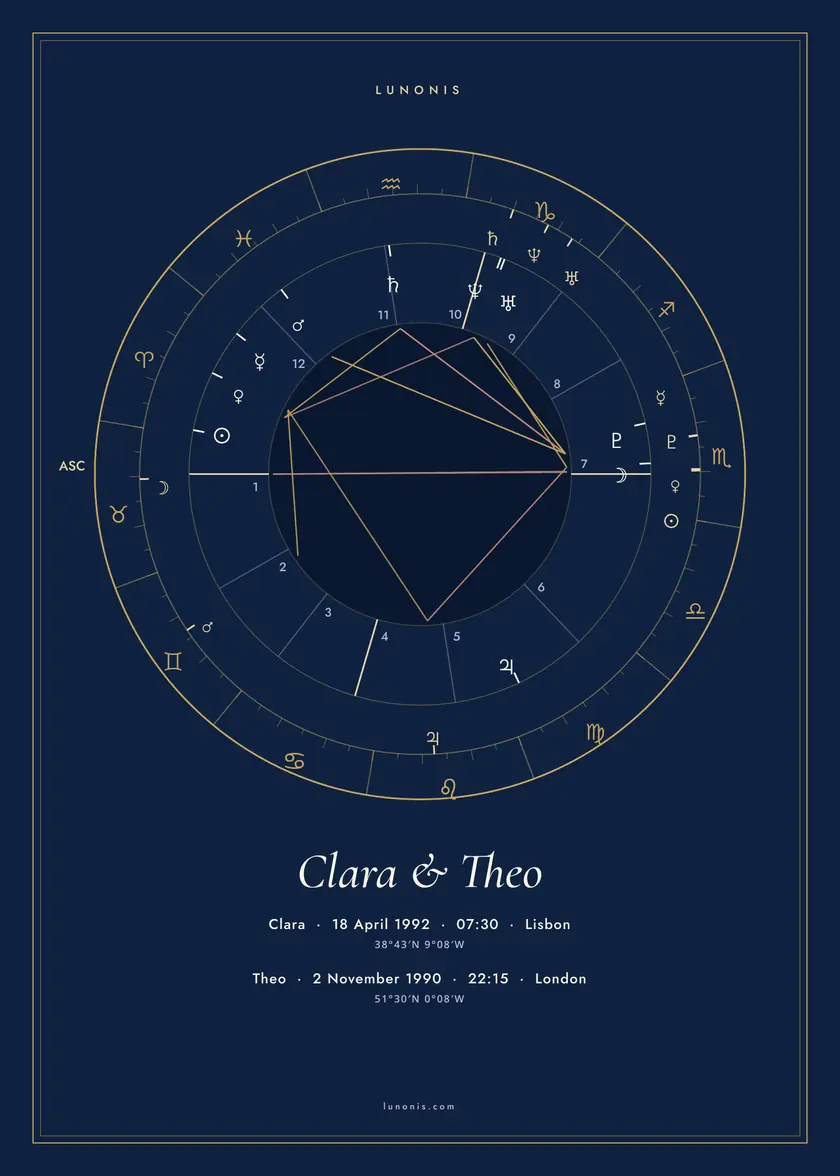
For the nursery wall, a natal chart poster shows the sky of the birth as a clean, quiet print. You can see finished books and posters on the examples page, and more ideas in our astrology gift ideas guide. If you want to start the book itself, the baby book needs only the date, time and place.
Whatever you choose, treat it as a first letter to someone you are still getting to know. The chart is a beginning, and the child will write the rest.
Questions people ask
How accurate does the birth time need to be?
Within a few minutes is ideal, because the Ascendant and the houses shift through the day. The time on the hospital or birth record is usually precise enough. If you only know the date, the signs of the planets and most aspects are still reliable.
Is it okay to read a baby’s chart?
Yes, as long as you treat it as a gentle portrait of tendencies and needs. Keep it free of labels and predictions, and let the real child always come first.
What do you look at first in a newborn chart?
The Moon, because it describes comfort and what helps a little one feel safe. Then the Sun, the Ascendant and the balance of the elements.
Can I give a baby book as a gift?
Yes. You only need the baby’s date, time and place of birth, so it is worth asking the parents first. The book arrives as a digital edition you can view online and keep as a PDF.