In this article
- Why Sun signs are only a first sketch
- What synastry is
- Which contacts carry the most weight
- Aspect families between two charts
- Elements: the easy pairs and the productive friction
- House overlays: where your planets land in their chart
- What synastry cannot tell you
- How to try it with your own charts
- Questions people ask
Why Sun signs are only a first sketch
Most compatibility advice starts and ends with two Sun signs. It is a fair place to begin: the Sun describes a person’s core drive, and some signs share a rhythm more easily than others. Yet the Sun is one of ten planets, plus the Ascendant, in each chart. Comparing two Suns means comparing two points out of more than twenty.
Take the two example charts used in this article. The first person has the Sun in Aries, the second in Libra. The page on Aries and Libra gives the Sun-sign view: opposite signs, a pull between independence and partnership. That is a true and useful picture, and it is also the outline of a much larger drawing. The full charts add the Moons, the love planets, the drive planets and dozens of angles between them.
The compatibility section has a page for every pair of signs. Use them as the overview, then come back here to see how astrologers go further.
What synastry is
Synastry is the comparison of two birth charts. The method is simple to describe: you place one chart inside the other, so both sets of planets sit on the same zodiac, and then you look at the angles that one person’s planets make to the other person’s. Those angles are called cross-aspects or inter-aspects.
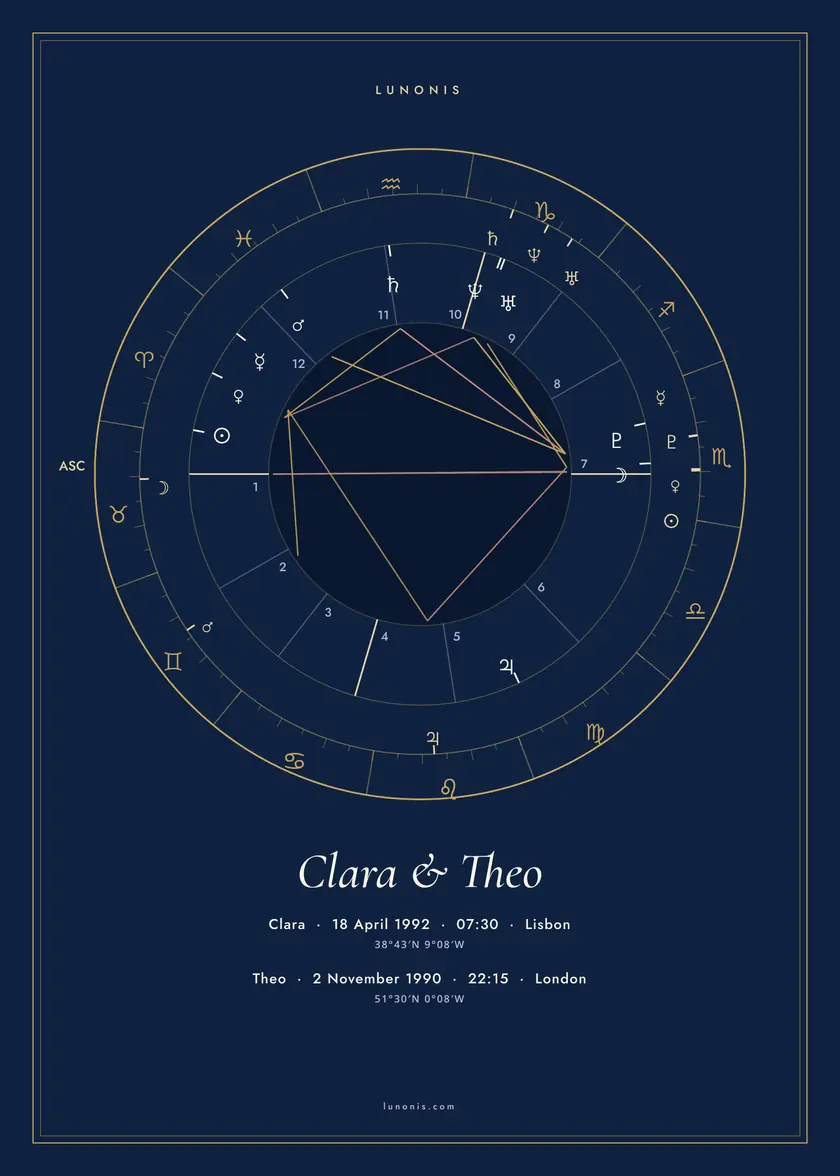
The cover of this article shows such a wheel. Person A is an example chart for a made-up birth on 12 April 1994 in Lisbon; person B is another made-up birth, on 27 September 1992 in Warsaw. They are not a real couple, only two charts chosen to show the method. A’s planets sit on the inner ring, B’s on the outer ring, and the lines across the middle mark the closest links.
Each link is read the same way as an aspect inside one chart, with one difference: it describes what happens between two people. When A’s Moon touches B’s Venus, the question is how A’s emotional needs meet B’s way of showing affection.
Which contacts carry the most weight
Not every link matters equally. Astrologers usually start with the personal points, because they describe daily life together:
- The Sun: identity and purpose. Links to the other person’s Sun or Moon show whether you recognise each other.
- The Moon: comfort, moods and home. Moon contacts often describe how easy it feels to simply be in the same room.
- Venus: affection, taste and what feels like love. See Venus for the planet itself.
- Mars: desire, energy and how each of you handles anger. Venus and Mars contacts are the classic markers of attraction.
- The Ascendant: first impressions and style. A planet on the partner’s Ascendant is felt right away.
- Saturn: duty, time and staying power. Saturn links can feel heavy at first and are often read as the glue of long commitments.
In the example, A’s Venus is in Taurus and B’s Venus is in Scorpio: opposite signs, the same axis of comfort and intensity that the Taurus and Scorpio page describes for Sun signs. If you only know your Venus signs, the Venus sign calculator is a quick way to start this comparison.
Aspect families between two charts
Synastry uses the same five major aspects as a single chart. Each family has a typical feel:
- Conjunction: two planets on the same spot. Strong, merging, sometimes too close for comfort.
- Trine and sextile: easy flow. Things work without much effort, which is pleasant and can be taken for granted.
- Square: friction that asks for movement. Sparks, misunderstandings and growth.
- Opposition: two planets facing each other. Attraction and polarity, a need to find the middle.
Between the two example charts there are 36 cross-aspects: 13 trines, 9 squares, 6 oppositions, 6 sextiles and 2 conjunctions. A mix like this is typical. Almost every pair of charts has both easy and difficult links, and a count says nothing on its own about how two people get along.
The tightest links matter more than the totals. Here they are Saturn △ Mars (trine), Jupiter □ Saturn (square) and Mercury ☍ Sun (opposition), always with A’s planet first and B’s second. Read them as themes for conversation. A’s Saturn in easy contact with B’s Mars suggests that structure and drive can support each other. A’s Jupiter squaring B’s Saturn hints at a tension between “more” and “enough”. A’s Mercury facing B’s Sun points to talks where one person’s ideas meet the other’s sense of self head on.
The grid is the working tool of synastry. Every row is one of A’s planets, every column one of B’s, and each filled cell is a link. Scanning it row by row shows quickly which of your planets is most involved with the other person, and which stays quiet.
You do not need to draw this by hand. The free calculator takes two birth dates, lays the charts side by side and lists the aspects between them, sorted by how close each one is.
Elements: the easy pairs and the productive friction
Behind the aspects sits a simpler pattern: the four elements. Signs of the same element are a trine apart, so planets in the same element tend to understand each other. Fire and air feed each other, as do earth and water; these are the classic easy pairs, linked by sextiles and oppositions.
Fire with water, or earth with air, is the uneasy mix, and the signs involved often fall a square apart. Uneasy here means unfamiliar. Square contacts between two charts tend to produce friction, and friction is also what moves people to explain themselves, adjust and learn something new. Many lasting relationships have plenty of it.
The example shows how elements cut across Sun signs. A’s chart leans to earth and water, with 4 planets in earth and 4 in water, while B has 4 planets in air and 0 in fire. On paper their Sun signs face each other across fire and air, yet underneath, A’s grounded and feeling style meets B’s airy, talk-it-through style. Neither is better: they describe two different ways of processing the same day.
A difficult aspect between two charts describes a place where you will need words, never a place where you will fail.
House overlays: where your planets land in their chart
A second layer of synastry asks where one person’s planets fall in the other person’s houses. If A’s Sun lands in B’s 7th house, B may experience A as a partner figure from the start; planets falling in someone’s 4th house tend to feel like home and family.
House overlays need both birth times, because the houses depend on the exact time and place. Without them, stay with signs and aspects, which already tell a lot. Our guide on how to read a birth chart explains the houses in a single chart first.
What synastry cannot tell you
Synastry describes patterns. It cannot tell you whether a relationship will work, how long it will last or whether you should stay. No chart comparison decides that, and anyone who scores couples out of a hundred is selling certainty astrology does not have.
Difficult aspects are not a warning sign. A square between two Moons can be the thing that teaches both people to name their needs. Easy aspects are not a guarantee either: a relationship full of trines can drift if nobody makes an effort. What two people choose, how they talk and how they repair after a quarrel matter far more than any angle on a wheel.
The most useful way to read synastry is as a shared vocabulary. It gives you neutral words for differences you already feel: “my Moon needs quiet, your Mars needs action” is easier to say than “you never stop”.
How to try it with your own charts
Start with what you know. Look up your two Sun signs on the compatibility pages, then check each other’s Moon and rising sign; our guide to the big three explains why those three points come first. Next, enter both birth dates in the compatibility calculator to see the full list of cross-aspects and the tightest links.
If you want to read a single chart with more confidence first, the birth chart calculator draws each of yours separately. And if you are looking for a thoughtful present for a partner, the gift ideas guide covers couple books and posters built from two charts.
Questions people ask
What is the difference between synastry and Sun-sign compatibility?
Sun-sign compatibility compares one point in each chart, usually by sign alone. Synastry compares all the planets and the Ascendant of two full charts and measures the exact angles between them, so two couples with the same Sun signs can have very different synastry.
Are squares bad in synastry?
No. Squares describe friction, and friction often keeps a relationship lively and pushes both people to grow. They point to areas that need patience and clear words, which is useful to know, not a reason to worry.
Do we need both birth times for synastry?
For the planet-to-planet aspects, a birth date is enough for most planets, though the Moon can change sign within a day. For the Ascendant and house overlays you need both birth times and places.
What is a composite chart?
A composite chart blends two charts into one by taking the midpoint of each pair of planets. It is read as the chart of the relationship itself, while synastry shows how the two individual charts interact.